

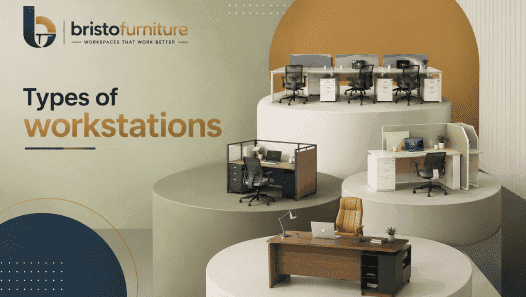
Choosing the right workstation layout is an important decision for any corporate office. Workstations influence how employees collaborate, concentrate, communicate and use available floor space. A well-planned workstation system can help businesses create an organized workplace while supporting changing team sizes, technology requirements and working styles.
For companies planning a new office, renovation or expansion, understanding the types of office workstations available makes it easier to select a layout that matches business requirements. From space-efficient bench systems to flexible modular designs, each workstation configuration offers different advantages.
Bristo Furniture provides professionally designed office workstation solutions for corporate workplaces, with a focus on functionality, durability, customization and efficient space utilization. As an office workstation manufacturer in Bangalore, Bristo Furniture works with businesses looking for practical workstation configurations suited to modern commercial environments.
Why Workstation Selection Matters in Corporate Offices
A workstation is more than an individual desk. In a modern office, it becomes part of the overall workplace infrastructure, influencing circulation, privacy, collaboration, storage, cable management and employee comfort.
Leading workplace-furniture manufacturers also emphasize adaptability. Haworth describes workstation systems as solutions designed to evolve with changing workplace requirements, while its benching systems combine multiple workstations into compact configurations. Herman Miller similarly highlights workstation systems that can accommodate changing organizational needs, technology and different work styles.
For businesses sourcing workstations in bulk, the right configuration can also help standardize the office environment across departments while keeping installation and future expansion manageable.
1. Bench Workstations
Bench Workstations are designed by positioning multiple desks together in a shared configuration. They are particularly suitable for open-plan corporate offices where teams need efficient use of floor space without creating individual enclosed cabins.
A bench workstation layout can support departments such as IT, finance, customer support, operations and administration. Shared cable-management channels, screens and storage options can be incorporated according to the workplace requirement.
For companies looking for a bench workstation manufacturer or supplier in Bangalore, the design should be evaluated based on team size, floor dimensions, circulation requirements and future expansion.
2. Cluster / Pod Workstations
Cluster or Pod Workstations group employees into defined team-oriented units. Instead of arranging desks in a continuous row, pods can create smaller working zones within a larger office.
This configuration is useful for corporate teams that regularly communicate while still requiring individual work areas. Screens or partitions can be incorporated where some visual separation is required.
Pod layouts are often suitable for project teams, technology departments, design teams and collaborative business functions. A bulk workstation supplier can also customize pod sizes according to the number of employees assigned to each department.
3. Open Bay Workstations
Open Bay Workstations are designed for larger open-plan office environments. They create organized work zones while maintaining a visually open workplace.
This layout can work particularly well for companies with multiple departments operating on the same floor. Open bays can be planned with shared storage, privacy screens, electrical access and structured cable management.
For businesses expanding rapidly, open bay systems can offer a practical approach to arranging larger employee groups without using excessive enclosed partitions.
4. Height-Adjustable Workstations
Height-Adjustable Workstations allow users to alternate between seated and standing working positions. They are increasingly considered for modern corporate environments where employee comfort and workstation flexibility are priorities.
Haworth's office systems include height-adjustable benching that supports sit-to-stand working, while its HAT Elements system provides adjustable sitting and standing positions.
For companies selecting these systems, important considerations include adjustment mechanism, desk stability, power management, available workspace and the number of users requiring adjustable functionality.
Businesses seeking height-adjustable workstations in Bangalore can consider customized configurations based on employee roles, workstation dimensions and office layout.
5. L-Shape Workstations
L-Shape Workstations provide an extended working surface by combining two perpendicular desk sections. This makes them suitable for employees who manage multiple monitors, documents, equipment or different work activities.
The L-shaped configuration can also make effective use of corners and defined areas within corporate offices. It is commonly considered for managers, supervisors, designers, analysts and employees requiring additional desktop space.
A professional office workstation manufacturer in Bangalore can customize dimensions, finishes, storage and cable-management requirements to suit the available workplace.
6. Modular Workstation Systems
Modular Workstation Systems are designed around configurable components that can be rearranged or expanded as organizational needs change. They can include work surfaces, partitions, storage, screens, cable management and supporting accessories.
Modularity becomes especially valuable for companies that frequently reorganize departments or increase employee capacity. Herman Miller's Ethospace system, for example, uses interchangeable components to support workplace changes and reconfiguration.
For corporate buyers placing bulk workstation orders, modular systems can provide a more scalable approach than fixed layouts.
7. HAT Workstations
HAT Workstations are designed to support flexible workplace configurations with adjustable working heights. They can be used where organizations want a more adaptable workstation environment without moving away from a structured corporate layout.
Haworth's HAT Elements system is described as a scalable workplace system with adjustable standing and sitting positions and multiple configurations.
HAT workstations can therefore be considered for technology companies, corporate offices, shared work environments and organizations seeking flexible desk arrangements.
8. 120 Degree Workstations
120 Degree Workstations use angled desk arrangements to create compact team-oriented configurations. The geometry can provide individual working areas while supporting communication between nearby employees.
This type of layout can be useful where companies want more interaction than conventional straight-line desks while still maintaining defined work zones.
The 120-degree approach is also supported across commercial workstation systems. Haworth offers 120-degree configurations within its height-adjustable benching range, while Herman Miller's systems include 120-degree planning options.
9. Cubicle Workstations
Cubicle Workstations create defined individual workspaces using partitions or screens. They are appropriate for corporate environments where employees need a balance between personal workspace and the benefits of an organized open office.
Cubicles can help establish visual boundaries for focused tasks while allowing businesses to maintain standardized workstation layouts. Depending on the design, organizations can incorporate storage, monitor arms, electrical access and other workplace accessories.
They can be particularly suitable for finance, administration, customer service and other departments where employees spend substantial time working independently.
10. Desking Systems
Desking Systems provide a structured foundation for organizing multiple employee work areas. They can range from simple shared desk arrangements to more sophisticated configurations incorporating screens, storage, power and cable-management components.
Bristo Furniture currently lists Desking Systems within its official workstation portfolio and describes them as solutions designed to support comfort, productivity and teams of different sizes.
For organizations ordering furniture for a new corporate facility, desking systems can provide a consistent visual and functional language across departments.
How to Choose the Right Office Workstation
The best workstation is not necessarily the most expensive or visually complex option. It should match the organization's workflow, workforce and available space.
Before selecting a workstation system, businesses should consider:
- Number of employees: Determine current and expected headcount.
- Available floor area: Account for workstations, circulation, meeting areas and storage.
- Work style: Consider whether teams require concentration, collaboration or a combination of both.
- Privacy requirements: Select screens, partitions or open configurations according to the nature of work.
- Technology: Plan for monitors, power points, networking and cable management.
- Future expansion: Modular and reconfigurable systems can be valuable for growing organizations.
- Ergonomics: Consider workstation height, desk dimensions and employee comfort.
- Budget: Compare material quality, customization, installation and long-term value rather than focusing only on initial price.
For large organizations, working with an experienced office workstation supplier or manufacturer can simplify planning, customization, bulk procurement and installation.
Why Choose Bristo Furniture for Office Workstations?
Bristo Furniture positions its workstation offering around practical design, customization and commercial workplace requirements. Its official website states that the company designs, manufactures and installs customized office workstations, with planning based on office layout, team size, workflow and business requirements.
The company also highlights precision manufacturing, professional installation and tailored configurations, making it relevant for businesses looking for a workstation manufacturer, supplier, dealer or bulk office furniture partner in Bangalore.
Its workstation portfolio currently includes Desking Systems, Cubicle Workstations, 120 Degree Workstations, L-Shape Workstations and HAT Workstations, while its broader workstation offering can be explored through the official service page.
Final Thoughts
The different types of office workstations give companies considerable flexibility when designing modern corporate workplaces. Bench workstations can support space-efficient team layouts, pod systems can encourage collaboration, height-adjustable solutions can provide flexible working positions, while modular systems can accommodate future changes.
For businesses planning office interiors in Bangalore, the selection should be based on employee requirements, floor planning, workflow, technology, privacy, scalability and long-term durability.
Whether you need workstations for a growing startup, a large corporate office, an IT facility or a complete commercial fit-out, selecting the right workstation configuration can make the workplace more organized, functional and adaptable.
Bristo Furniture – Office Workstation Manufacturer & Supplier in Bangalore
Bristo Furniture provides customized office workstation solutions for modern corporate environments, including workstation planning, manufacturing and installation. Businesses looking for best office workstations in Bangalore, bulk workstation solutions, workstation suppliers, manufacturers or dealers can explore Bristo Furniture's official workstation portfolio and discuss their workplace requirements with the team.