

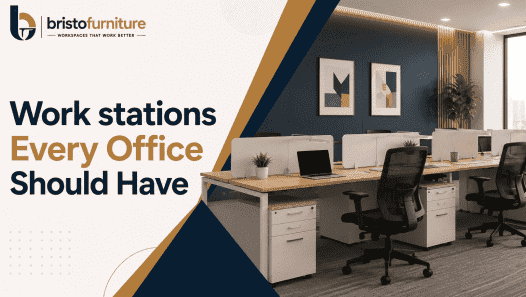
A modern corporate office needs more than desks arranged in rows. The right workstation setup can influence how employees collaborate, concentrate, organize equipment and use the available floor space. As businesses expand and workplace requirements become more varied, choosing the right workstation configuration becomes an important part of office planning.
Different departments work in different ways. A software development team may need an open collaborative arrangement, while finance employees may benefit from more defined work areas. Managers may require larger surfaces, and growing companies may prefer systems that can be reconfigured as teams change.
This is why there is no single workstation configuration that suits every corporate office. Instead, businesses should combine practical workstation types according to their workforce, floor plan and working requirements.
Bristo Furniture's official workstation portfolio includes several commercial configurations, including desking systems, cubicle workstations, 120-degree workstations, L-shape workstations and HAT workstations. The company positions these solutions around comfort, durability, space utilization and workplace productivity.
Why Every Office Needs the Right Workstation Mix
Workstations are central to most employee work areas. They determine how much usable desk space employees have, how teams are positioned, where equipment is placed and how easily people can move through the office.
A good workstation plan should also work with chairs, storage, lighting, power and technology. OSHA's computer-workstation guidance emphasizes that desks and chairs should be appropriately selected and arranged so employees can work in more neutral positions and avoid unnecessary awkward postures.
Therefore, selecting workstations should begin with understanding the work being performed rather than simply choosing the most attractive design.
1. Bench Workstations for Team-Based Offices
Bench workstations are a practical choice for offices where multiple employees need to work within a shared area. Several work positions are arranged together, creating a consistent and organized layout.
They can work particularly well for IT teams, operations, finance, customer support and other departments where employees need individual desk space while remaining part of a larger team.
The major advantage is efficient planning. Instead of treating every employee's desk as a completely separate unit, businesses can organize several positions into a unified system.
For growing companies, bench layouts can also make future expansion easier when additional positions need to be added within the same department.
2. Cluster or Pod Workstations for Collaborative Teams
Cluster and pod arrangements organize employees into smaller groups. They can be useful for teams that communicate regularly but still need clearly defined individual work areas.
A pod configuration can create a natural team zone within a larger office. Project teams, technology departments, creative teams and operations groups can benefit from this arrangement when regular interaction is part of their daily work.
The layout also gives businesses an opportunity to organize shared power, cable management and storage around a defined group rather than distributing these elements randomly across the floor.
3. Open Bay Workstations for Larger Employee Floors
Large corporate offices often need a workstation arrangement that can accommodate many employees without making the floor feel unnecessarily fragmented.
Open bay configurations can help organize larger employee groups into structured zones. They can be considered for IT offices, service centers, operations departments and other environments where several employees perform similar functions.
However, efficient use of space should not mean simply fitting more desks into the room. Walkways, access to storage, employee movement and emergency routes still need to be considered during planning.
A successful open layout should feel organized rather than overcrowded.
4. Modular Workstation Systems for Growing Businesses
Growing companies should think beyond their current employee count. A workstation system that works today may become difficult to manage when a department expands, relocates or changes its team structure.
Modular systems can provide greater flexibility because components and configurations can be adapted to changing requirements.
They can be particularly useful for businesses experiencing:
- Employee growth
- Department restructuring
- Office expansion
- Internal relocations
- Changing team sizes
Bristo Furniture describes its modular office furniture approach as involving requirement understanding, space planning, manufacturing, implementation and handover. Its official process emphasizes creating solutions around the client's actual workspace requirements.
5. Cubicle Workstations for Focus and Privacy
Open offices are useful for collaboration, but not every employee needs to work in a completely open environment.
Cubicle workstations provide defined work areas using partitions or screens. They can offer a practical middle ground between open benching and fully enclosed offices.
They may be suitable for departments where employees need greater visual separation for focused work, including finance, administration, customer service and certain analytical roles.
Bristo Furniture's official workstation portfolio includes cubicle configurations designed to provide employees with their own defined work areas while helping businesses use office space efficiently.
6. L-Shape Workstations for Roles Needing More Workspace
Some employees require more working surface than a standard desk can provide. Designers, managers, analysts and employees working with multiple monitors or physical documents may benefit from an L-shaped configuration.
The extended surface can support different activities without requiring the employee to move between separate desks.
L-shaped systems can also make effective use of corner areas, although businesses should use them selectively. Installing larger desks throughout an office when only a few employees need them can unnecessarily consume valuable floor space.
Bristo Furniture includes L-shape workstations within its official commercial workstation portfolio and describes them as solutions that provide additional workspace while making use of corner areas.
7. 120-Degree Workstations for Efficient Team Layouts
Angled workstation configurations can create an alternative to conventional straight desk arrangements.
A 120-degree layout can provide defined employee positions while keeping team members relatively close to one another. This can be useful for departments where employees work independently but need frequent communication.
The geometry also creates a distinctive office layout without requiring fully enclosed workspaces.
8. HAT Workstations for Flexible Working Positions
Some corporate environments require more flexibility than a conventional fixed-height desk can provide. HAT workstations can be considered where businesses want adjustable working positions within their employee areas.
These systems can support different working preferences and can be incorporated into modern corporate layouts where flexibility is an important consideration.
However, adjustable furniture should be selected based on actual workplace requirements rather than installed simply because it is a popular feature.
How to Decide Which Workstations Your Office Needs
Most offices do not need to select just one workstation type. A better strategy is to create a mix based on employee roles and department requirements.
For example, a corporate office might use:
- Bench systems for large employee teams
- Pod layouts for collaborative departments
- Cubicles for focused work
- L-shape configurations for specialized roles
- Modular systems for areas expected to expand
- Adjustable configurations where flexible working positions are useful
This approach avoids spending money on features that employees may not actually need.
Start With Employee Requirements
Consider how employees spend their working day. Do they collaborate frequently? Do they use multiple monitors? Do they handle confidential information? Do they require large working surfaces?
The answers can help determine the most appropriate configuration.
Plan the Floor Before Ordering Furniture
Accurate measurements are essential. Businesses should consider work areas, walkways, meeting rooms, storage, entrances and shared facilities before finalizing workstation quantities.
Think About Technology
Modern offices depend on monitors, laptops, networking equipment, power connections and charging devices. Cable management and electrical access should therefore be incorporated into the furniture plan.
Allow for Future Changes
If the company is growing, the workstation layout should leave room for additional employees or department changes.
Workstations and Office Chairs Should Work Together
A workstation cannot be considered independently from the chair used with it.
Seat height, desk height, monitor position and keyboard placement all influence the employee's working position. OSHA recommends appropriately adjusting the chair together with the monitor, keyboard and desk.
For example, a workstation may look compact and efficient, but if an employee cannot position their chair correctly beneath the desk, the layout may not provide the intended comfort.
Bristo Furniture also offers office seating as part of its wider commercial furniture portfolio, including executive, mesh, meeting and boardroom seating.
What to Look for When Buying Workstations
When purchasing furniture for a corporate office, businesses should evaluate more than the initial quotation.
Important considerations include:
- Material and construction quality
- Workstation dimensions
- Cable-management provisions
- Customization options
- Space-planning capability
- Installation support
- Delivery schedules
- Warranty and after-sales support
- Ability to handle bulk requirements
For a large office project, consistency is also important. Workstations should maintain similar dimensions, finishes and specifications across departments unless a particular role requires a specialized configuration.
A reliable manufacturer or supplier should also be able to understand the office layout and recommend configurations based on actual workplace requirements.
Choosing a Workstation Manufacturer for Your Office
The furniture partner you choose can influence the efficiency of the entire office project. Businesses should look for a company that can support more than product supply, particularly when the project involves customized dimensions, multiple workstation configurations or large quantities.
Bristo Furniture states that it provides space planning, interior design, modular furniture manufacturing and installation as part of its office-furniture services. Its official process covers requirement understanding, space planning, manufacturing, implementation and project handover.
For businesses searching for a workstation manufacturer in Bangalore, this end-to-end approach can be useful when furniture needs to be coordinated with an office interior project.
For larger corporate requirements, procurement teams can also discuss bulk orders, customization and installation requirements directly with the supplier.
Why Bristo Furniture for Corporate Workstations?
Bristo Furniture positions its workstation offering around practical workplace design, space utilization, comfort and durability. Its official portfolio includes several configurations designed for different corporate requirements, including desking systems, cubicle workstations, 120-degree workstations, L-shape workstations and HAT workstations.
The company also describes itself as a modular office furniture manufacturer in Bangalore and explains its process from initial requirement understanding through space planning, manufacturing, installation and handover.
Its broader office furniture offering includes workstations, tables, storage and office chairs, allowing businesses to coordinate multiple furniture categories within one corporate project.
For companies looking for a workstation manufacturer, supplier, dealer or bulk procurement partner in Bangalore, the appropriate solution should ultimately be based on the office layout, employee requirements, configuration and project scope.
Final Thoughts
Every office does not need every type of workstation. What every office does need is a workstation strategy that reflects how its employees actually work.
Bench and open layouts can support larger teams, pod arrangements can encourage communication, cubicles can provide defined work areas, while modular systems can give growing businesses greater flexibility. L-shape and angled configurations can address specific space and workflow requirements, while adjustable systems can provide additional flexibility where it is genuinely useful.
The best office furniture plan combines different solutions instead of forcing every department into the same layout.
Before making a purchase, businesses should consider employee roles, available floor space, technology, privacy, collaboration, future growth and compatibility with office chairs and other furniture.
With careful planning and the right commercial furniture partner, a corporate office can become more organized, adaptable and efficient without relying on unnecessary furniture features.
Bristo Furniture – Corporate Workstation Solutions
Bristo Furniture provides commercial office furniture solutions for modern workplaces, including workstations, tables, storage and office chairs. Its workstation range is designed around different team sizes, office layouts and professional working requirements.
Businesses searching for workstation manufacturers, suppliers, dealers, wholesale solutions or bulk workstation procurement in Bangalore can explore Bristo Furniture's workstation portfolio and discuss their corporate project requirements.